
Exterior Listing Photos in the Upstate: How to Time the Light on Greenville and Spartanburg Homes
A Greenville agent called me back in July about a house off Augusta Road that had been sitting for three weeks. The interior photos were clean. The front of the house looked like it had been shot inside a cave. The house faces west, the shoot got booked for 9:30 in the morning, and the entire facade sat in its own shadow the whole time we were there. Nothing was wrong with the camera. The time slot was wrong.
The exterior is the one frame you cannot fix later. It is the thumbnail, it is the first thing a buyer sees on their phone, and they decide whether to keep scrolling in about a second. Here is how we plan exteriors around the Upstate, and the part you can handle before we pull in the driveway.
Which way the front faces decides your time slot
Before you pick a time, find out which direction the front of the house points. Pull the address up in satellite view, remember that north is up, and look at which side the driveway and front door sit on. Takes about twenty seconds and it saves the whole shoot.
East-facing fronts want a morning slot. West-facing fronts want late afternoon. South-facing fronts are the easy ones and hold decent light most of the day. North-facing fronts are the problem children, because in summer they never get direct sun on the facade at all, so we either shoot them on a bright overcast day or catch them late in the evening when the light is warm and skimming across the yard.
The clock moves on you, too. In August the sun is still high and harsh over Greer and Simpsonville until close to 7pm, so a west-facing front does not really come alive until after 6:30. That same house in November is dark by 5:15. Same direction, same address, completely different booking.
The Upstate has a tree problem, and it shows up in photos
Older Greenville neighborhoods like North Main, Alta Vista and Augusta Road are full of mature oaks. So is Converse Heights over in Spartanburg. Beautiful to stand in. Rough to photograph. What you get is dappled light: half the facade lit, half in shadow, and sharp leaf-shaped patches across the brick in between.
Your eye compensates for that. A camera sensor does not. You end up with blown-out white patches and black holes in the same frame, and no amount of blending brings back detail that was never recorded. We bracket and blend every exterior, but blending only helps when there is something living inside the shadow. A leaf pattern across brick stays a leaf pattern.
What actually works on a tree-heavy lot is even light. Wait until the whole front sits in open shade, or shoot on a fully overcast day, or come back late enough that the sun is off the facade while the sky still has color in it. Agents sometimes apologize for a gray forecast. On a wooded lot, that gray day is often the best light we are going to get. Save the blue-sky mornings for the open lots out toward Anderson.

The ten-minute curb list
This is the part sellers can knock out themselves, and it matters more than any camera decision we make. Send it to them the day before, along with the room-by-room prep list for the inside.
Cars out of the driveway and off the street in front. Ask the neighbor to move theirs too if they are parked across the frame.
Trash and recycling bins behind the house or in the garage.
Garage door closed, unless the garage is genuinely a selling feature.
Hose coiled, grill pulled off the front walk, kid toys and yard tools out of sight.
Mow two days before, not the morning of. Clippings settle and the mower lines stop looking like corduroy.
Fresh mulch is the cheapest curb upgrade in the Upstate. Red clay showing through a bed reads as neglect in a photo even when the house is spotless.
Sprinklers off the night before so the driveway and walk are dry, not blotchy.
Every porch and coach light bulb working, and matched. One dead bulb is obvious in a dusk frame.
None of that is exciting. It is the difference between a front we can shoot once and a front we spend forty minutes shooting around.
How we actually shoot the front
A few things we hold to on every exterior, and you are welcome to hold your other vendors to them as well.
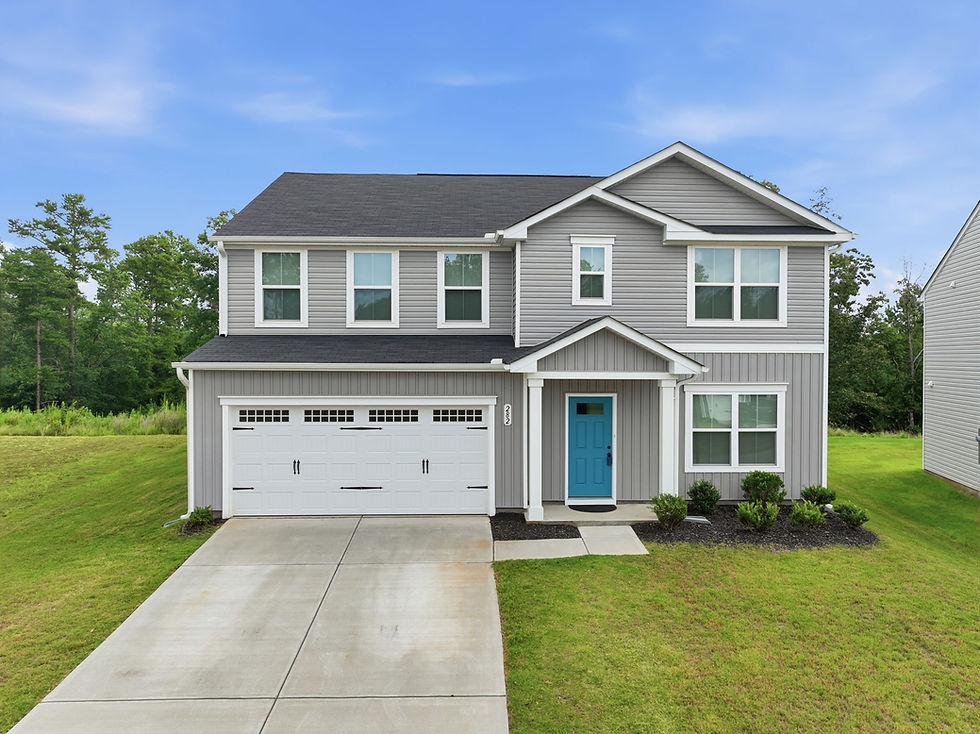
Camera at roughly chest height, about five feet. Go higher and the roof swallows the frame. Go lower and the lawn takes over while the house appears to lean away from you.
Verticals dead straight. The corners of the house run parallel to the edge of the frame. A leaning house is the single fastest way to make a listing look like it was shot on a phone.
Around 16 to 20mm on full frame for the main wide shot. Push wider than that and the walls bow, the driveway stretches out like a runway, and the house ends up looking smaller than it really is.
Three-quarter angle as the hero frame, straight-on as the second. The angled shot shows depth and roofline, which a flat frontal shot flattens out.
Color temperature locked across the whole set, so the front, the back and the yard all read as the same afternoon instead of drifting orange and blue.
On the blending: over-processed exteriors give themselves away every time. Gray halos tracing the roofline against the sky, a sky rendered at the same brightness as the siding, grass that seems to glow from underneath. If a photo makes you squint trying to figure out what is off, that is usually it.

When an aerial earns its spot, and when it does not
An aerial is not automatically an upgrade. It earns a place in the set when the ground shot cannot tell the story: real acreage, a long approach, water, a roof worth showing, or neighborhood context. On a wooded lot around Greenville the aerial is often the only frame that shows a buyer where the property actually ends, and from the right altitude on a clear day you get the Blue Ridge sitting on the horizon behind the house. That does more for the location than a paragraph of listing copy.
Where it does not help is a tight interior lot in a newer subdivision, where the aerial mostly shows the neighbor's roof and somebody's above-ground pool. Skip it and put that money into more interior frames.
One practical note if you are hiring drone work anywhere in the Upstate: commercial flights require a Part 107 certificated pilot, and both GSP and Donaldson sit in controlled airspace, so a good bit of Greer, Taylors and southern Greenville needs LAANC authorization before the drone comes out of the case. That approval is usually instant, but it has to happen. Ask any drone vendor for their certificate number and proof of insurance. Anybody doing this properly will hand both over without blinking. There is more on how we handle drone work across Greenville, Spartanburg and Anderson if you want the longer version.
The honest part: sometimes exteriors are not worth a second trip
If the front of the house is plain and the property really sells on its interior or its lot, you do not need a perfect facade. Two clean exteriors plus a strong interior set beats twelve angles of a vinyl ranch every time. Frames are not free, and neither is the buyer's attention.
Same goes for the calendar. If the yard is beat up in February, the honest play is to shoot the house well now and come back for a couple of seasonal frames in April, rather than pretending. We would much rather redo two exteriors in the spring than have you explain a brown lawn to every buyer who pulls up to the curb. Most of the rest of what we have learned is written up in our 2026 listing playbook for South Carolina and Virginia.
Want a hand with your next Upstate listing?
Beyond All Media shoots listing photos, drone, video and 3D tours across Greenville, Spartanburg, Anderson, Columbia and Richmond. Carolinas (864) 714-0724, Richmond (804) 913-3013.


Comments